
Author: Dr. Simon Pierce
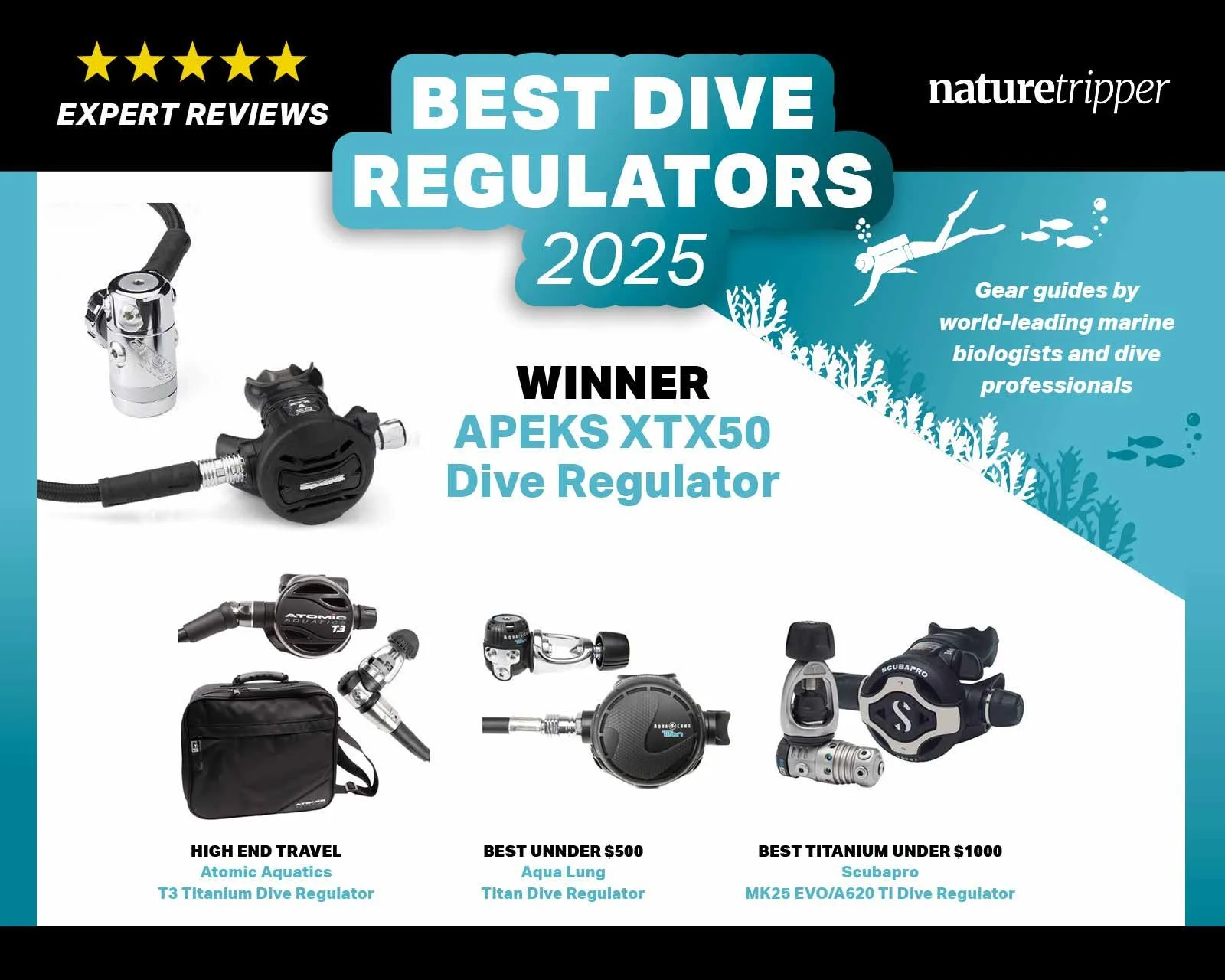
I’m Simon, a marine biologist and underwater photographer. I’m lucky enough to work in remote areas like Raja Ampat and the Galapagos Islands so when it comes to my dive equipment, I need gear that is reasonably lightweight, reliable, and effective. My scuba regulator is vital to the success of my trip, and gear failure would be a real problem. I’ve been diving happily with Apeks regulators for three years, and hundreds of dives, and the APEKS XTX50 Dive Regulator is my pick for the Best Scuba Regulator for 2025.
A quick survey of my dive buddies made me pretty happy with my choice:
Danny Copeland, Underwater Filmmaker: “Apeks or GTFO. Literally not worth even considering another reg brand. Hardest part is deciding which shiny Apek reg you want.”
Dr. Elitza Germanov, Lead Scientist, Marine Megafauna Foundation: “Love my Apeks! Over 2000 dives in Komodo’s howlers.”
Javier Sales, PADI Course Director: “I own 12+ XTX50’s and have for a long time. The best reg there is.”
I’ve also identified the Best High-End Dive Regulator for Travel, along with our other top picks for Best Regulator Under $500, and the Best Titanium Regulator Under $1000. Read on!
BTW, I’ve listed all our winners for best dive gear here that includes my best Dive computers, Dive Masks, Dive Fins, BCDs, Regulators, and Full-Face Dive Masks in 2025.
Overall Winner: APEKS XTX50 Dive Regulator
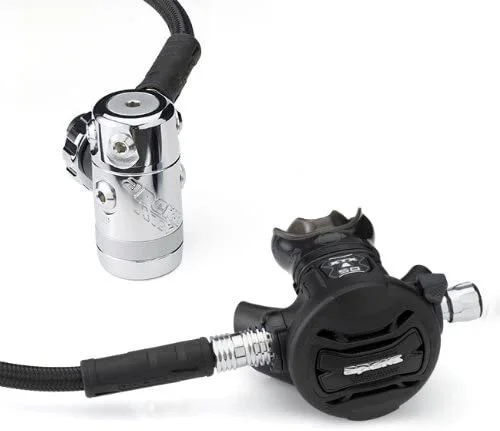
The Apeks XTX50 is the go-to choice for serious divers who focus on performance and durability. As a BBC filmmaker buddy of mine put it: “Apeks or GTFO.” They also look great, if that matters to you. You can get strengthened versions with metal plates if that’s useful to you, or if you particularly enjoy diving in freezing conditions. Me… not so much. But these regulators will do it all.
You might think a dive regulator like this must be expensive, but it’s actually not unreasonable. It’s firmly on the ‘affordable’ end of the scale compared to, say this Titanium ScubaPro with all the bling that costs over 4x more. Which admittedly, is very shiny, but my Apeks has proven to be a superb long-term choice for me, and I highly recommend the XTX50.
As a photographer I love the Apeks’ changeable wide exhaust system that directs bubbles away from my face as I exhale, minimizing destabilization of my camera gear. This is great for all divers, but especially useful for photographers.
Its braided flexi-hose is lightweight and tough for regular travel, the system features an over-balanced first stage to ensure optimal performance and airflow at depth, and it still breathes well even when I’m frantically trying to catch up with whale sharks. The first stage also has plenty of ports to attach my computer transmitter, a back-up air gauge, or a second tank would be fine if you’re so inclined. It’s just a fantastic all-round dive regulator.
I put this gear guide out to my marine biologist and pro diver friends, who came back with:
- “I’ve used the same Apeks reg for 7 years now and it has never failed me. Their parts are pretty much interchangeable with Aqualung so you can find them everywhere, and they can be serviced by any competent dive operator.”
- “Yes Apeks. Doesn’t matter which. All are tanks.”
- “Apeks are always great!”
- “I swear by Apeks.”
- “I can teach you how to service them. They’re very, very easy.”
Consensus achieved.
Best High-End Travel: Atomic Aquatics T3 Titanium
The T3 is the signature dive regulator from Atomic Aquatics, the “finest regulator you can own” in their words. If you can afford it, it’s a super-high-end regulator with an advanced, patented airflow control system. The T3 regulator is extremely lightweight and made from corrosion-resistant materials which make it a great choice for travel to hard-to-reach locations with limited baggage.
Best Under $500: Aqua Lung Titan Regulator
This regulator performs well for its price and if you’re a warm-water recreational divers who wants your own basic dive regular, or as a backup to a more expensive regulator like the Atomic T3, this may well do the job for you. In fact, we saw a diver buy this as a backup to the Atomic, but now prefers using this one day-to-day as it’s easier to pull apart and service.
Aqua Lung regulators have long been an industry favourite as a tough and reliable choice within dive centres. The Titan will be fine in the tropics, but note these do not perform well in the cold or at depth without their add-on environmental kit. If you are planning on diving below 80’, or in chilly water below 50 degrees, you could consider the Apeks which is about $100 or so more.
Best Titanium Under $1,000: Scubapro MK25 EVO/A620 Ti
The Scuba Pro MK25 EVO range is extremely popular go-to choice for experienced divers. The second stage is titanium, and first stage a chrome-plated brass (there is a full titanium version here for double the price). It features a thermally-insulated system for high performance in chilly water, and a beautifully balanced effortless breathing system.
Author Credentials
Simon J Pierce is a shark conservation biologist and world-renowned underwater photographer who dives, snorkels and freedives for a living. He is a co-founder and Principal Scientist at the Marine Megafauna Foundation, where he leads the global whale shark research and conservation program. His marine research and photography are routinely covered by major media outlets, including the BBC, National Geographic, Discovery Channel, and New York Times amongst many others. One of his photographs was chosen as a personal favourite of Sir David Attenborough’s, in conjunction with the BBC Blue Planet II series, and another illustrates one of the global PADI scuba diving certification cards.
Madeleine Pierce is an avid scuba diver and recreational freediver who’s done hundreds of dives at some of the most spectacular locations around the world, including Misool and northern Raja Ampat, Lembongan, Lembeh Straight, Tulamben, Fiji, Vanuatu, and of course at home in Australia. She’s a minimalist and likes to travel light (which Simon encourages, as he can then use her baggage allowance!!), opting to mostly hire dive and snorkel gear wherever she goes. She’s been sampling the world’s equipment for over a decade. She has opinions.
How We Tested
We looked at all the current models from top brands globally to find the best dive regulators on the market in 2025. Aside from our own personal experience with lots of different computer models, we spent hours watching YouTube Reviews and product explainers, arguing with eachother, debating with diver friends, and scouring reviews and message boards. To summarize:
- Between us, we’ve done around 2,500 dives and used lots of different regulators. Mads has chosen to rent gear everywhere she goes to save on travel weight so has experience with lots of models.
- We spent 15 hours doing dive regulator research on Amazon, LeisurePro, and various other scuba message boards to get up-to-date on what’s available.
- We both read hundreds of reviews to determine the actual performance of the various features.
- We spoke to dive shop owners in Australia and Indonesia to find out what they use and recommend.
- We surveyed our extensive network of professional divers (scuba instructors, professional underwater photographers, marine biologists etc) to get their opinions and feedback.
- We watched dozens of YouTube reviews and product explainers, gathering multiple opinions.
What to Look For in a Dive Regulator
A regulator is the 1st + 2nd stage + hose. Be aware this is what is included, and you’ll purchase the occy and pressure gauge separately. Some people who buy expensive regulators will buy a cheaper occy since it doesn’t get used as often, though we recommend buying the same brand if possible to ensure ease of servicing, and many will offer packages or sets.
Key considerations:
- How recent is it? The latest releases are usually easier to service, very old models are harder to service.
- Do users love it? Real-world reviews are the best reviews.
- Port configuration – The first stage is where you attach your Second stage hoses, transmitters, pressure gauges, and BCD inflator hose. Some are swivel for flexibility, some are fixed which can bang you in the head.
- Yoke or DIN – This is how you attached the first stage to the dive tank. A-clamp is the traditional clamp for max 230 BARR pressure and widely used in the US. DIN is a modern version used in Europe that takes up to 300 BARR.
- Pressure balance – Over-balanced Dive Regulators are easier to breath at depth.
- Weight – If you’re traveling you’ll want a lightweight model. The lightest metal is Titanium, and the lightest hose material is a threaded hose.
- Ease of Servicing – Just like with cars, some models are easier to service with easier to find parts.
- Construction – Quality construction is essential for safe diving.
- Cold or warm water diving – If you’re going tropical diving go Titanium or Chrome plated marine grade brass. If you’re going arctic diving you’ll want stainless steel.
Understanding Regulator Components
FIRST STAGE: Takes pressure from your cylinder and converts it to a breathable pressure.
- 2 x bigger high-pressure ports are for your gauges and dive computer transmitters.
- 4 or 5 x low-pressure ports reduce the low pressure to ambient pressure and are for connecting your second stage main air supply, occy, and your BCD inflator hose.
SECOND STAGE: The part you stick in your mouth
- Purge button – Button usually on the front
- Breath adjustment – most come with this so you can adjust the breathing resistance
- Venturi lever – works to prevent a free flow when you first dive in
PORT CONFIGURATIONS:
- Spoke - Common but not ideal as can angle hoses away from body
- 90° - Angled out sideways makes hose routing more natural
- Angled - Direct hoses away from eachother in a natural angle
- Swivel Turret - get this one if you can as it gives complete flexibility
Materials
- Titanium: lightweight and strong, popular for travel regs, but doesn’t work well in cold water or oxygen levels above 40%. Perfect for tropical diving travel.
- Chrome-plated marine grade brass: very common, excellent for heat sync and does not rust. Everyday diving.
- Stainless Steel: not as common – great in cold water but need to keep dry when in storage. Great for arctic diving.
- PVD Coating: gives a dark look and increases toughness and durability.
Regulator Pressure Types
- Un-balanced: fine for most shallow recreational dives where water pressure is low, but as you go deeper, breathing will be harder and more forceful.
- Balanced: uses environmental pressure to adjust the interstage pressure inside the regulator to make it easier to breath.
- Over-balanced: performed like the ‘Balanced’, but has performance technology to makes it easier to breathe the further down you go down.
Servicing Your Dive Regulator
When you own a regulator you need to get it serviced at a dive shop. The service schedule and cost is different for all makes so be sure to check before you buy - some might be ‘after 100 dives’ or ‘after 1 year’.
- Newer regulators are usually easier to service as their parts are readily available.
- Older models are usually harder and dive shops might not be able to service them at all.
- This is a reason we love the Apeks, everyone can service them.
- Consider how often you’ll need to fork out cash for servicing.
- A lifetime warranty means you only pay for servicing, not the parts like O ring replacements etc.
Bubble Direction for Photographers
You don’t want to be lost in a sea of your own bubbles and for photographers especially this can be a big deal. Luckily there’s a range of second stage exhaust designs that expel air out the side like Simon’s Apeks top pick which has a wide exhaust that was especially designed with photographers in mind.
Summary
- APEX XTX50 Dive Regulator - Overall Winner
- Atomic Aquatics T3 Titanium Dive Regulator - Best travel high-end
- Aqua Lung Titan Dive Regulator - Best under $500
- Scubapro MK25 EVO/A620 Ti Dive Regulator - Best titanium under $1000